Friday, December 7, 2018

Control Procurement

CONTROL PROCUREMENT

Control Procurement is the process of
  • managing procurement relationships 
  • monitoring contract performance
  • making changes and corrections as appropriate
  • closing out contracts. 

The key benefit of this process is that it ensures that both the seller’s and buyer’s performance meet the project’s requirements according to the terms of the legal agreement. 

Each is required to ensure that both parties meet their contractual obligations and that their own legal rights are protected.
The legal nature of the relationship makes it imperative that the project management team is aware of the implications of actions taken when controlling any procurement. 

Change Management:
Agreements can be amended at any time prior to contract closure by mutual consent, in accordance with the change control terms of the agreement. Such amendments are typically captured in writing.
No adhoc changes. If it is not in the contract then neither party should agree to do a change without following the prescribed change management process. The intent should be of collaboration, else it may lead to more negotiation and/or subsequent dispute resolution.

Procurement Audits:
The quality of the controls, including the independence and credibility of procurement audits, is critical to the reliability of the procurement system. The organization’s code of ethics, its legal counsel, and external legal advisory arrangements including any ongoing anti-corruption initiatives can contribute to proper procurement controls.

Financials or Payments:
Ensure that payment terms defined within the contract are met and that compensation is linked to the seller’s progress as defined in the contract. A principal concern when making payments is to ensure there is a close relationship of payments made to the work accomplished.

A contract that requires payments linked to project output and deliverables rather than inputs such as labor hours has better controls.

Resource responsible for Contract administration:
On larger projects with multiple providers, a key aspect of contract administration is
managing communication among the various providers.
Because of the legal aspect, many organizations treat contract administration as an organizational function that is separate from the project. While a procurement administrator may be on the project team, this individual typically reports to a supervisor from a different department.


Saturday, March 25, 2017

Procurement SOW & Procurement Document

SOW & Procurement Document:

Statement of Work:
From Scope Baseline -> Procurement Statement of Work ->
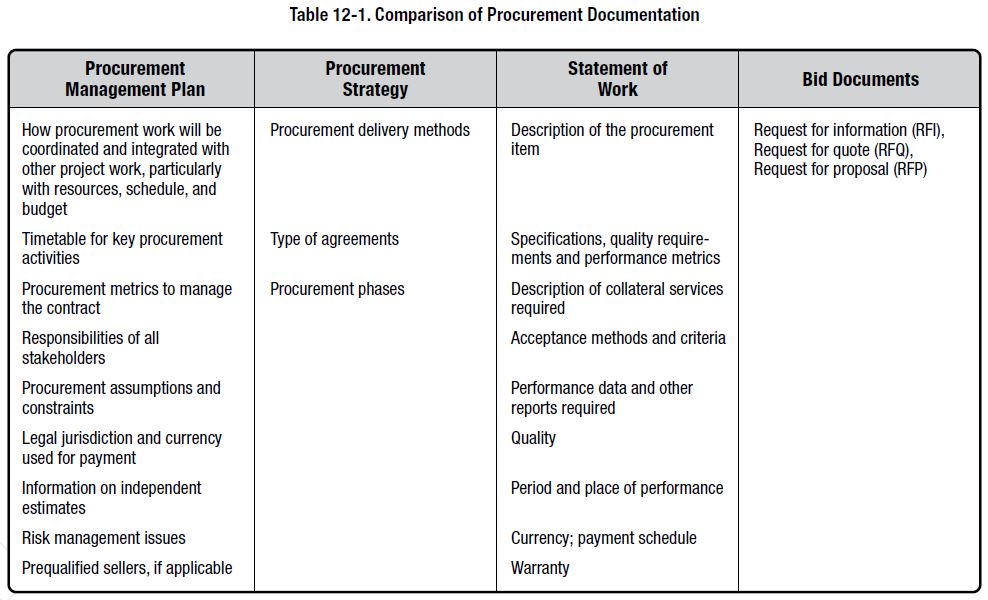
This has to be Clear, Concise, Completely define the Specifications, Quantity, Quality, Performance Data, Period of Performance, Performance reporting, Work location, post-project operation support and other requirements.
Procurement SOW could be iteratively revised as required as it moves through the Procurement process until incorporated into a signed Contract or Agreement.

This is done so that Sellers can clearly understand the requirements and determine if they are capable to deliver.


Procurement Document:

Procurement Document = Procurement SOW + Desired Form of response from sellers + sometimes Seller selection Criteria.


Procurement documents are also known as Bid documents or Terms of Reference (TOR).

Bid documents are used to solicit proposals from prospective sellers. Terms such as bid, tender, or quotation are generally used when the seller selection decision is based on price (as when buying commercial or standard items),
While term such as proposal is generally used when considerations such as technical capability or technical approach are the most important. The conditions involving their use are presented below:

  • Request for information (RFI). An RFI is used when more information on the goods and services to be acquired is needed from the sellers. It will typically be followed by an RFQ or RFP.
  • Request for quotation (RFQ). An RFQ is commonly used when more information is needed on how vendors would satisfy the requirements and/or how much it will cost.
  • Request for proposal (RFP). An RFP is used when there is a problem in the project and the solution is not easy to determine. This is the most formal of the “request for” documents and has strict procurement rules for content, timeline, and seller response

Terms of reference (TOR) is sometimes used when contracting for services. Similar to the procurement SOW, a TOR typically includes these elements:

  1. Tasks the contractor is required to perform as well as specified coordination requirements;
  2. Standards the contractor will fulfill that are applicable to the project;
  3. Data that needs to be submitted for approval;
  4. Detailed list of all data and services that will be provided to the contractor by the buyer for use in performing the contract, if applicable; and
  5. Definition of the schedule for initial submission and the review/approval time required.

Buyer sends Procurement Document to Sellers.
Buyer -> Procurement Document -> Seller 1 to n

Interested Sellers send each of their proposal to Buyer.                                         
Buyer <- Proposal 1 <- Seller 1
          <- Proposal 1 <- Seller n


Procurement introduction:

Procurement introduction:

Contract is a mutually binding legal agreement that
obligates the seller to provide the specified products, services, or results;
obligates the buyer to compensate the seller;
and represents a legal relationship that is subject to remedy in the courts.

The major components in an agreement or Contract document will vary, and may include but are not limited to:
- Procurement statement of work or major deliverables;
- Schedule, milestones, or date by which a schedule is required;
- Performance reporting;
- Pricing and payment terms;
- Inspection, quality, and acceptance criteria;
- Warranty and future product support;
- Incentives and penalties;
- Insurance and performance bonds;
- Subordinate subcontractor approvals;
- General terms and conditions;
- Change request handling; and
- Termination clause and alternative dispute resolution mechanisms.

Contract is also known by following names in different industries or countries:
Agreement, Subcontract, Purchase Order, Understanding, Memorandum of Understanding

Buyer is also known as
Client, Customer, Prime Contractor, Contractor, Purchaser, Acquiring organization

Seller is also known as
Vendor, Service Provider, Supplier

Contract life Cycle & Project life Cycle:
Various activities involved in Project Procurement Management processes form the life cycle of a Contract.

A complex project like real estate building may involve managing multiple contracts simultaneously or in sequence.
In such cases each Contract life cycle may end during any phase of the project life cycle.

Bid documents are used to solicit proposals from prospective sellers. Terms such as bid, tender, or quotation are generally used when the seller selection decision is based on price (as when buying commercial or standard items),
While term such as proposal is generally used when considerations such as technical capability or technical approach are the most important. The conditions involving their use are presented below:

  • Request for information (RFI). An RFI is used when more information on the goods and services to be acquired is needed from the sellers. It will typically be followed by an RFQ or RFP.
  • Request for quotation (RFQ). An RFQ is commonly used when more information is needed on how vendors would satisfy the requirements and/or how much it will cost.
  • Request for proposal (RFP). An RFP is used when there is a problem in the project and the solution is not easy to determine. This is the most formal of the “request for” documents and has strict procurement rules for content, timeline, and seller responses


Saturday, April 30, 2016

Procurement Contract Closure

Questions in the Closing process group account for 8% of the exam.

Close Procurement
Close Procurement supports the Close Project or Phase process but doesn’t necessarily happen at the same time.
However, to close the project, all procurement's must be closed.

Exception:
The exception to this is if you have open claims or appeals. Open claims are handled by the legal department.

To close out a procurement, you use the procurement management plan for the details and guidelines associated with contract closure. All procurement documents need to be indexed for lessons learned and future reference. Procurement documents include performance reports, invoices, and contractual change documentation. Your organization may use information from contractor performance reports and documentation to evaluate contractors for future work.

Termination of a contract
Contracts can be terminated for a variety of reasons, such as

  1. termination by mutual agreement, 
  2. termination for cause,  
  3. termination for convenience.


Terminating a contract by mutual agreement: 
If both parties agree that the contract should be cancelled, they need to follow the requirements in the termination clause of the contract. Be aware that termination for cause and termination for convenience have different contractual obligations associated with them.

Termination for cause
Termination for cause occurs when either party has breached or is about to breach the contract. This is also known as defaulting on the contract.
Here are two examples of seller default:
The seller can’t deliver the quality of work promised, and there is no evidence that the seller will be able to.
The clause Time is of the Essence is in the contract, and it’s abundantly clear that the seller can’t meet the delivery date.
The following are examples of buyer default:
The buyer is in significant arrears for payment, and it’s obvious that the buyer can’t catch up on back payments and make future payments.
The buyer is obligated to provide some element or component of the deliverable for the seller to be able to complete the contract. If the buyer doesn’t deliver the element, the buyer is defaulting on its part of the contract.

Termination for convenience
Many contracts have a clause that allows the buyer to terminate the contract at its convenience. Examples of reasons to terminate for convenience include the following:
Another project takes higher priority, and the company decides to cancel or delay the current project.
The market changes, and there is no longer a need for the project.
Because of a reorganization, new leadership has other priorities.
Financial landscape has shifted. A company’s quarterly earnings were worse than expected, and the organization has decided to cut costs based on projected earnings.

Saturday, December 21, 2013

Plan Procurement Management

Plan Procurement Management:
How to determine which project needs are to be met by procurement instead of being developed by project team. Basically how to arrive at Procurement decision.
How to identify potential sellers?
How to evaluate sellers?
How to procure?
How much to procure?
How to decide when to procure?
How to determine which type of Contract to be used?
How to determine the risks in a contract?
How to manage Risks?
How to manage multiple vendors?
How to manage procurement with other aspects of Project scheduling, Project reporting etc?
How to carry out the Make or Buy decision?

Contract:
Contract can also be called an agreement/subcontract/purchase order.
Generally Contract is a legally & mutually binding between buyer and seller, which must meet the needs of the project while adhering to the organizations procurement policies.
Language describes product, svc, or results needed
Complex projects can have multiple contracts.
Various activities involved in the Project Procurement Management processes form the life cycle of a contract.
Contract or contract lifecyle can be end once it is done. And this can happen in any phase of the project.
Contract & Contract type is also a tool used to share/transfer risk between buyer and seller.


Diff between Contract and Agreement:
An agreement is an informal compromise between two or more parties, which may or may not be legally binding.
A contract is a legally-binding agreement that is entered into voluntarily by two or more parties, with the intention of creating one or more legal obligations among them.